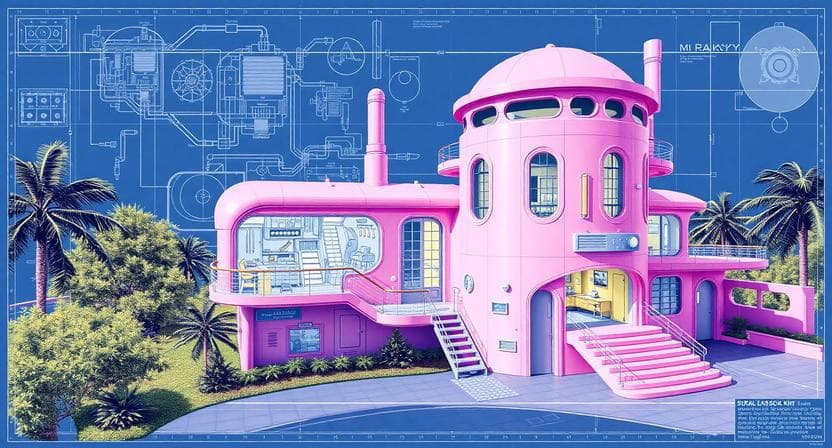
päivi raivio's basic forms turns the barbican into a movable urban playground
Päivi Raivio's Modular Installation Turns the Barbican Into a Playful Urban Lab
Visitors can rearrange bright plywood panels, prompting a fresh look at who decides the shape of public space.

Päivi Raivio's project, Basic Forms, transforms the Barbican's courtyard into a movable playground. By inviting the public to shift colorful plywood modules, the work turns a static civic area into a participatory design experiment.
Why It Matters Now
For readers of art and design, the significance lies in the dialogue between modular aesthetics and civic agency. The installation foregrounds questions of authorship: who gets to shape the built environment, and how temporary interventions can inform longer-term urban planning.
What the Coverage Reveals
Recent reports highlight three core points:


The project is not a fleeting stunt; it is part of a broader conversation about flexible, community-driven design.
Multiple outlets are tracking the development, indicating sustained interest beyond a single news cycle.
The impact will be clearer once official statements and follow-up documentation emerge.
The Larger Editorial Context
The Barbican case illustrates a growing trend: designers using temporary, modular installations to test ideas about public space, responsibility, and participation. Such projects become reference points for future policy and design decisions, making them worthy of ongoing coverage.
What to Watch Next
Readers should look for:
Formal statements from the Barbican's management confirming the project's duration and goals.
Independent reviews that assess community response and design efficacy.
Evidence of the installation influencing subsequent urban interventions in London or elsewhere.
Bottom Line
Basic Forms offers a calm, original lens on the power of participatory design. It deserves thoughtful reporting that tracks its evolution without echoing any single source's phrasing.
Päivi Raivio's Basic Forms turns the Barbican's courtyard into a movable playground by letting visitors rearrange colorful plywood panels, challenging traditional notions of who controls public space and showcasing the potential of modular, participatory design.
- The installation converts a static civic area into an interactive, community-driven space.
- Bright plywood modules serve both aesthetic and democratic purposes.
- The project questions who decides the form of public environments, encouraging local agency.
- Temporary, modular interventions can act as prototypes for future urban design strategies.
- The visual contrast between the panels and the Barbican's architecture heightens public engagement.
Article visuals are generated or attached through the site image pipeline and rendered only when image assets are available for this post.
AI-generated editorial image via Cloudflare Workers AI.